
Which STEM kits and tabletop logic games complement each other without repeating the same skill? Start with a physics-kit candidate beside a slide-puzzle candidate, then make the color-and-counting lines compete for space. The revealing contrast is making an arrangement work versus finding a move that satisfies a rule—not two boxes carrying different educational labels.
The, January 11–14, 2027, at, gives that comparison a practical setting. Start with the difference between assembling a working arrangement, manipulating a ready-made activity surface and making a rule-based move. Then make the counting-and-letter reference compete with the animal-sorting family on the actual activity each offers.
Shortlist scope
These 6 catalogue candidates are comparison references, not confirmed 2027 exhibits or launches. Ages below are supplier catalogue fields, not independently verified suitability; all dimensions describe packaging rather than assembled toys.
Where should the fair tour begin?
Begin with Educational Toys & Games, the directly relevant sector in the. Establish the play loop there before branching into material or technology themes. Green Toys and AI & Smart Toys are also listed, but neither label answers whether the player builds, investigates, reasons or sorts.
The Stationery & School Supplies fair runs concurrently, making it a useful secondary comparison for classroom presentation. Keep that detour subordinate to the toy shortlist: first identify a genuinely different activity, then consider how clearly its instructions and presentation communicate the task.
Construction and manipulation: a kit or a ready-made activity surface?
Treat them as different demonstration questions, because the activity-table photograph does not establish an assembly task. is catalogued as a wooden experiments science kit in a colour box, with a ‘3 Years’ age field and 60 × 40 × 15 cm package. Its supplied text does not identify the experiments or full contents.
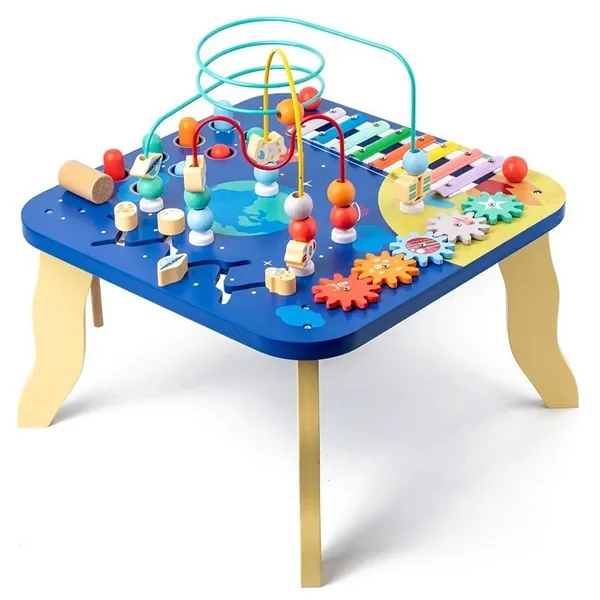
The contrasting is titled a 5-in-1 wooden busy-board table/STEM science kit, with No Battery in the raw record. Its actual photo shows a tabletop wire-bead maze, coloured xylophone bars, intermeshing gears, pegs and a mallet. These support a manipulation-and-feedback comparison, without proving a kit the player builds, a five-lesson curriculum or measured learning gains.
The table lists 7–9 years, 10–12 years, 13–14 years and over 14 years. Those fields place it differently from the experiments kit's 3-year listing; they do not create an established developmental ladder.
Its 41 × 18.5 × 41.5 cm package and 42.5 × 38.5 × 43.5 cm outer case belong to packing, not the assembled table's height or footprint. The recorded case holds 2 units, MOQ 18, at USD 18.07–19.79. The wooden-kit reference is USD 6.95–7.61, structured MOQ 36 beside a raw 3-carton minimum, without a reliable case count connecting them. Those are separate order records, not a demonstrated age or quality ladder.
For the table, follow one bead around a wire, turn a gear and compare striking a bar with the other hand actions. For the wooden kit, establish what is assembled and what can subsequently be changed before allocating it a construction role. The broad material and age labels do not answer either question. The kit's 5.0 kg trade gross-weight entry is not a measured bare-toy weight or proof that its package contains a particular apparatus.
Mechanism: make the physics set earn its own slot
is catalogued as an 8-in-1 physics science play set made from wood and plastic. Its age field is 3 years and up, and its color-box package measures 29 × 12 × 29 cm.
The most useful fair demonstration is a transition between activities. Follow setup, change an input or arrangement, observe the response, and then watch the move to the next activity. This separates the appeal of constructing an object from the appeal of investigating its behavior.
That transition also resolves the important component question: does the next activity reuse dismantled parts, or come from a separate sub-kit? Shared-part rebuilding and independently available activities offer different play rhythms; the “8-in-1” title alone does not settle which format is supplied.
Give this candidate the mechanism role when changing and observing are central. If assembly is the main event, put it in direct competition with the wooden experiments kit instead. The shelf needs a different loop, not simply another science-themed box.
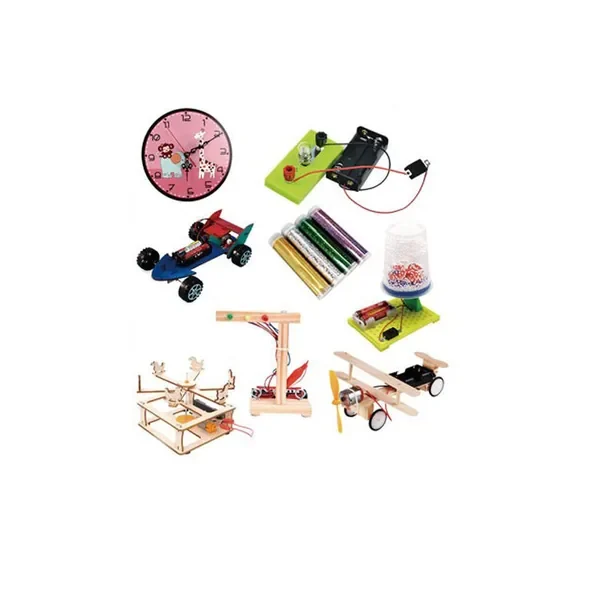
The actual TW305842 collage shows several separate arrangements, including a clock face, wheeled wooden builds, a wired holder with a small propeller-like component and a cup arrangement. That provides more specific fair comparison material than the title alone. It does not demonstrate that eight complete models can be built simultaneously, or identify which power cells and instructions are supplied.
The reference is USD 6.32–6.88, MOQ 60, with 30 units per case, 19.4 kg gross/17.4 kg net and 0.149 cubic metres recorded. The 29 × 12 × 29 cm colour box is a package measurement. Preserve these terms beside the exact activity version, rather than comparing its eight-in-one name directly with the table's five-in-one name as if both counted the same thing.
Logic: follow an unsolved position
is the provisional logic candidate, catalogued as an ABS Sudoku Super Slide puzzle game. Its package measures 25 × 20 × 10 cm.
The listed age bands are 5–7 years, 8–13 years and 14 years and up. For a range spanning those bands, the useful demonstration is how the challenge is presented and restarted—not a solved board held up for inspection.
Begin with an unsolved position and follow a legal move, the completion condition, recognition of an error and reset. Locate the rule: is it expressed by the arrangement, by instructions, or by another person's prompt? Locate the feedback in the same way.
This is the distinction to carry into matching-game discussions. Moving pieces can be a logic challenge or simply a response to a prompt. Give the logic slot to the demonstrated rule system, rather than assuming that “smart” means automatic answer checking.
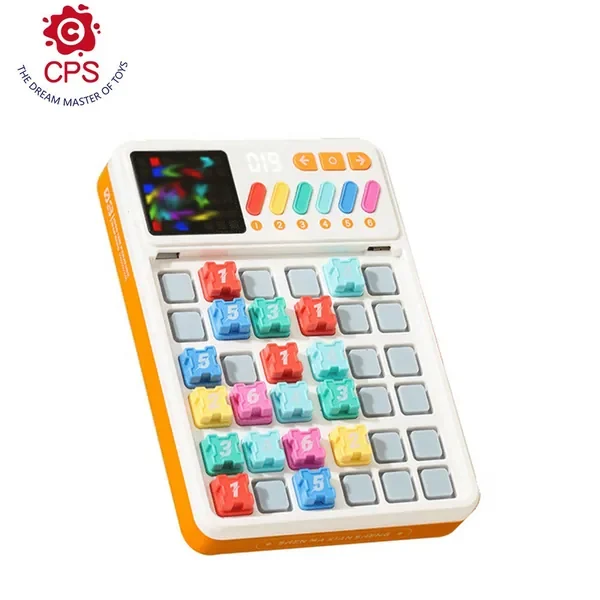
The selected TW298380 photo makes a rule demonstration worth requesting: a numbered board with coloured raised pieces, grey positions, an upper screen-like panel, coloured selector keys and arrow/home-style icons. It does not supply the full rules, confirm automatic checking or establish a companion app. Keep the player's move, the permitted arrangement and the actual feedback as separate observations.
Its structured price reference is USD 9.70–10.60 and MOQ 20, with no reliable carton quantity. The 25 × 20 × 10 cm trade package is not a measured board face, and the generic 6.0 kg gross-weight field does not establish handheld weight. The broad age bands are supplier fields; the numbered face is not evidence that this uses conventional Sudoku rules.
Color and counting: which candidate should be cut?
Make these two references compete for the same initial slot, then retain both only for a demonstrated difference. TW281858's title additionally names letters, which is a useful comparison question; the title alone does not prove a separate literacy activity or justify discarding the animal family.
combines counting, color matching and letters in its catalogue title. Its color box measures 23.5 × 17.3 × 6.4 cm. At the fair, establish whether letters create a different task or simply replace the symbols in the same matching action.
The competing lists ABS material under the combined reference TW312865-Toy. Record the exact variant demonstrated rather than treating that family reference as a single contents list.
Retaining both requires a visible difference in player action or rules. Animals in one package and letters in another are a merchandising contrast, but the buying decision should turn on what the player actually does. Catalogue overlap justifies making them compete; it does not establish that they share a mold.
TW281858 has a USD 3.79–4.33 reference, MOQ 24 and a 23.5 × 17.3 × 6.4 cm colour box; its 0.71 kg entry is trade gross weight. The animal family's reference is USD 3.20–3.50 and structured MOQ 120. Its raw 3 Cartons and 40PCS/CTN entries occur in a shifted table, with no clean structured case count. Do not turn that arithmetic into a verified mixed-animal pack or assign it to all three model suffixes.
Carry this play map onto the fair floor
Give each candidate a primary role. These provisional placements turn demonstrations into comparable observations instead of a collection of unrelated sales presentations.
| Shelf role | Provisional candidate | Competing candidate | Deciding observation |
|---|---|---|---|
| Construction or manipulation | TW183048 as an assembly question | TW305229 as a ready-made activity table | Does the player build the apparatus or manipulate its existing parts? |
| Mechanism exploration | TW305842 | The construction choice | Does changing an input or arrangement produce an observable response? |
| Rule-based logic | TW298380 | Prompt-led matching | What makes a move legal, a result complete and an error recognizable? |
| Color, counting and letters | TW281858 | TW312865-Toy animal family | Do letters and animal sorting produce different tasks, or mainly change the theme? |
Keep retail boxes separate from carton quantities
Record retail presentation separately from the replenishment pack. TW305229 lists 2 units per carton and an 18-unit minimum; TW305842 lists 30 per carton and a 60-unit minimum. The counts describe different supply formats, without establishing relative sales volume, freight cost or how many children each product serves.
Use the demonstration to decide the product's role first. Then attach its package and carton information to that role, so an appealing display does not obscure how the actual wholesale unit is presented and replenished.
How do you turn the shortlist into useful meetings?
Request a complete play sequence for the missing shelf role, using these models as comparison references rather than assuming an exhibitor carries them. “Show an activity where changing the arrangement changes the result” is a tighter brief than “show your STEM range.”
Click2Match is scheduled for January 4–21, 2027; runs December 11, 2026–February 10, 2027. Those windows frame preparation and follow-up around the physical fair.
starts through To Visit when registration is available. It covers personal or SSO information, company details, business-matching categories and purpose, followed by an email after successful registration.
On the floor, opens product details from booth or product QR codes and provides favorites, chat, enquiries and meeting scheduling. Save the exact variant, then request an in-person or online discussion around its proposed role; scanning alone does not confirm a meeting.
For arrival planning, places Exhibition Centre MTR station, Wan Chai MTR station and Wan Chai ferry pier within a 10-minute walk.
Prepare the comparison list before Hong Kong
Use ToysWholesaler's Start an RFQ to send the candidate references, market, quantity and timing, adding the intended shelf role beside each. Carry that same list into the fair: retain products for distinct reasons to play, and cut the ones whose demonstrations repeat a job already covered.