
Choose cornhole for a dedicated backyard lane and singles or doubles play; choose another toss game when storage, available space, or group rotation matters more. In a cornhole vs. toss games comparison, ladder toss favors a shorter setup and flat packing, washer toss offers another option for varied surfaces, and KanJam adds a partner-deflection role. For family, camp, and school buyers, the practical decision is whether one set fits the actual activity—or whether two complementary formats serve the group better.
Cornhole is itself a toss game. The useful comparison is between formats, not between two separate product categories. Match the throwing area, number of participants per round, packed size, accessory kit, and style of group play before choosing a construction or finish.
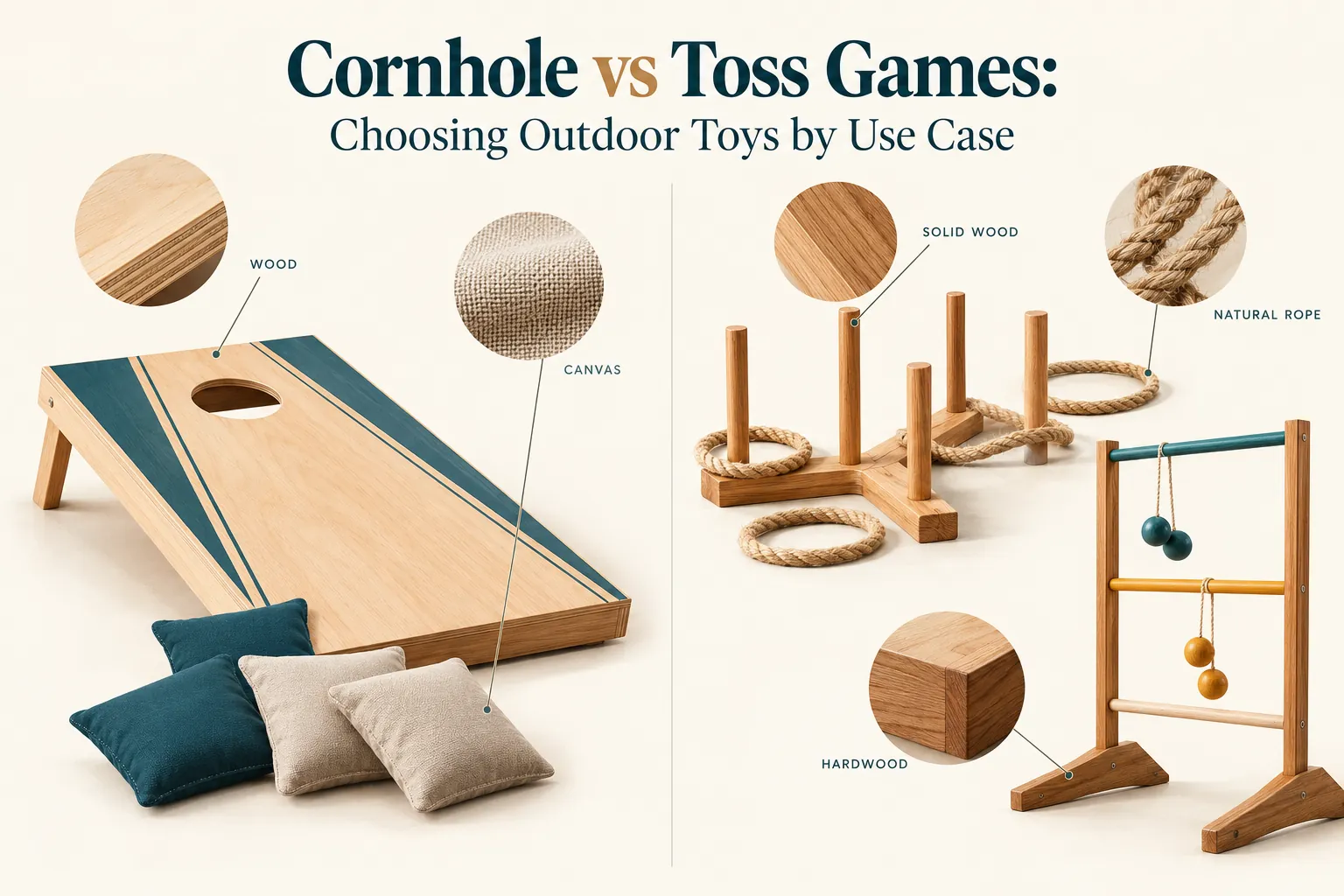
How much space should buyers allow for cornhole and other toss games?
Measure the complete playing area, not just the distance between targets. Standard-distance cornhole uses 27 feet between the boards’ front edges, while casual family play can use a shorter distance. That shorter setup is a deliberate adaptation, not a full-distance court. Cornhole setup guide
For an initial layout, Blue Haven suggests approximately 40 feet of length and 10 feet of width for cornhole, about 15 feet between ladder-toss targets, and roughly 20 feet for washer toss. These are planning references, not interchangeable court dimensions or universal safety clearances. Leave room for the equipment, players, and retrieval route when checking the actual site. Blue Haven
KanJam needs a disc-throwing lane rather than a compact target station. The supplied guides conflict on goal spacing: Finds We Trust lists 17 feet, while Blue Haven lists 50 feet. Do not treat those figures as an interchangeable setup range; verify the required spacing against the selected set’s instructions before deciding whether it fits, and keep the lane separate from neighboring activities. Finds We Trust Blue Haven An inflatable target’s oversized appearance also says little about its required playing area: check both inflated dimensions and the intended throwing distance.
How do the six toss-game formats compare for families, camps, and schools?
| Rigid-board cornhole | Players: singles or two-person teams, taking turns. Footprint: 27 feet between board front edges at standard distance; shorten for casual play. Storage: compare packed board dimensions, folding legs, and carry arrangement. Accessories: confirm boards and a complete matching bag set. Group format: head-to-head matches with cancellation scoring. Family fit: choose for a dedicated backyard game. Camp fit: choose for a fixed activity area rather than a tightly packed mobile kit. School fit: use as one station, with a separate rotation plan for the wider group. |
|---|---|
| Ladder toss | Players: organize opposing individuals or teams under the selected rules. Footprint: approximately 15 feet between ladders, plus player and retrieval space. Storage: choose a breakdown-flat design and check its packed dimensions. Accessories: confirm ladders, all assembly parts, and matching bolas. Group format: alternate throws at scored rungs. Family fit: a practical shortlist for a shorter yard. Camp fit: favor when flat packing is important. School fit: use for a target-scoring station rather than whole-class simultaneous play. |
| Washer toss | Players: organize opposing individuals or teams; establish the set’s rules before play. Footprint: roughly 20 feet as a planning reference. Storage: specify the packed arrangement of boxes and loose washers. Accessories: confirm target boxes, recessed cups where applicable, and matching washers. Group format: alternating target throws; rules vary by set and region. Family fit: consider where the available surface makes board setup awkward. Camp fit: shortlist for varied activity surfaces, then check stable target placement. School fit: select when staff can manage accessory counts and consistent station rules. |
| KanJam | Players: four, arranged as two teams of two. Footprint: a dedicated disc lane laid out to the selected set’s instructions. Storage: check goal breakdown, packed dimensions, and disc storage. Accessories: confirm both goals and the specified flying disc. Group format: partners alternate throwing and deflecting roles. Family fit: choose when partner interaction and lawn space are priorities. Camp fit: use at an open-field station. School fit: a strong shortlist for a four-player cooperation activity, but not a whole-class capacity solution. |
| Inflatable ring toss | Players: individual turns; rotate participants through the station. Footprint: mark an adjustable throwing line and allow room around the inflated target. Storage: confirm deflated packing and any base-weight storage needs. Accessories: check target, rings, inflation method, and any manufacturer-specified weighting components. Group format: target attempts or a buyer-defined team relay. Family fit: choose for casual target play. Camp fit: reserve for suitable conditions and manageable inflation arrangements. School fit: use as a rotating target station, not as an inherently high-capacity game. |
| Inflatable cornhole | Players: individual or team turns under the selected set’s rules. Footprint: use the actual inflated dimensions and chosen casual throwing distance. Storage: deflates for flat packing; confirm the packed kit size. Accessories: verify targets, bags, pump requirements, and included components. Group format: casual bag-toss rounds rather than an assumed competitive-board substitute. Family fit: choose when deflated storage and an inflatable target are priorities. Camp fit: accept only when inflation and ground conditions suit the activity. School fit: consider for occasional stations where staff can manage setup and pack-down. |
When should a family buyer choose wooden cornhole instead of an inflatable?
Choose wooden cornhole for board-based match play; choose inflatable cornhole when deflated storage matters more than reproducing that playing surface. An inflatable is not simply a wooden set with easier storage—it changes the target construction and playing experience.
For a family assortment, keep wooden cornhole as the main match format if the yard and storage area accommodate it. Add an inflatable only when it serves a distinct casual-play or packing need. Vinyl introduces puncture considerations, so do not treat an inflatable as a direct substitute for every wooden-board use. LawnLeagues describes inflatable cornhole as a party-oriented format that packs flat, rather than a competitive wooden-board replacement. LawnLeagues
For younger participants, adjust the casual throwing distance and follow the selected product’s age and supervision instructions. An inflatable target is not, by itself, evidence that a product is suitable for every child.
Can the same cornhole set serve a family, camp, and school?
| Family backyard: dedicated playing area and nearby storage | Decision: shortlist the wooden cornhole set. A household can organize singles or doubles without needing a separate activity for an entire class-sized group. Keep standard-distance play only if the complete lane fits; otherwise agree on a shorter casual layout. The carry bag helps organize the set but does not reduce the boards’ packed dimensions. Choose inflatable cornhole instead only if deflated storage is the deciding requirement. |
|---|---|
| Camp: shared equipment store and changing activity locations | Decision: choose ladder toss as the primary mobile option when breakdown-flat storage is the priority. Retain the same wooden cornhole set only for a site with a suitable recurring lane and sufficient transport space. If surface conditions are the constraint, shortlist washer toss and check target stability on the intended ground. A carry bag alone does not resolve packed volume or site suitability. |
| School: a larger group rotating through activities | Decision: use the same cornhole set as one station, not as the complete group activity. Choose KanJam instead when the learning activity calls for throwing-and-deflecting partner roles and a suitable disc lane is available. Choose ladder toss or ring toss for a different target station. If several small groups must participate at once, specify enough separate stations; changing the game name does not remove waiting time. |
What should buyers verify before choosing one format or two?
Approve one format only when it passes the site layout, participation, and packed-kit checks for every intended use case. Otherwise, buy complementary formats rather than forcing one set into incompatible settings.
Request an assembled layout and a packed-kit measurement for each shortlisted set. Mark the throwing line, target positions, waiting area, and retrieval route at the actual site. Then run the intended group rotation on paper: distinguish participants assigned to a team from participants taking an active turn.
Check the complete accessory kit against the proposed activity, including bags, bolas, washers, rings, or discs, plus inflation equipment where needed. For washer toss, write down the chosen rules because scoring conventions vary by set and region. Blue Haven
For a family with a suitable lane, one cornhole set may be enough. For a mobile camp, ladder toss may be the better primary purchase. For a school, prioritize a workable station plan before selecting the format mix. Buy a second game to solve a specific space, storage, or participation problem—not merely to add another box.