
Choose a musical activity gym in a color box and a light-up bow-and-arrow set in a display box as separate replenishment lines, each with its own carton record. For a mixed wholesale toy order, approve the assortment only after each line has an agreed pack count, dimensions, weights, and remainder arrangement. Combining products on one purchase order does not mean combining them inside one shipping carton—or using one product’s carton figures for another.
The practical choice is to keep standard single-SKU cartons wherever they suit your receiving process, then identify any agreed mixed or partial cartons separately. That gives the buyer a usable assortment plan and the warehouse a carton-by-carton receiving record.
Which product records help build the mixed-order shortlist?
| Musical lion activity gym and play mat | Assortment role: activity-gym/play-mat line. Recorded packing: color box. Reference master-carton quantity: 18 units. Recorded material field: wood; confirm which component it describes rather than treating it as the construction of the entire play mat. |
|---|---|
| Light-up bow-and-arrow set with target and suction-cup arrows | Assortment role: outdoor target-play line. Recorded packing: display box. Reference master-carton quantity: 24 units for the listed configuration. Recorded material: plastic. Give each selected variation its own order row and confirm the allocation within each carton. |
Should different toys share a purchase order or a shipping carton?
Use one mixed purchase order for the selected assortment, but keep separate carton identities unless mixed-carton contents have been explicitly agreed. A combined order and a mixed-content carton are different arrangements.
For replenishment received by product line, prefer single-SKU master cartons: the warehouse can assign each carton to one item without splitting its contents across inventory records. Choose a mixed-content carton when the agreed small quantities justify it and receiving can work from a carton-specific contents list. That list should state every included variation and quantity, not merely “assorted toys.”
A display box also needs a defined counting unit. Specify whether an order unit means one retail set or one populated display, and record how many retail sets fit in each display and master carton. Otherwise, “24 units” can be interpreted differently on the order and at receiving.
What belongs in the SKU-level carton worksheet?
| Item and revision identity | Supplier item identifier; buyer item identifier; product name; category; variation; PO number and line; packing-configuration revision; worksheet revision and date. |
|---|---|
| Catalog reference | Recorded retail packing, material description, and units per master carton. Keep these separate from the order-confirmed values. |
| Agreed order and pack | Ordered retail units; units per inner or display; units per master carton; single-SKU or mixed-carton arrangement; full-carton count; remainder units; agreed remainder packing. |
| Pre-PO shipping-carton proposal | External length × width × height with measurement units; calculated CBM; gross and net weights with units and their measurement basis; proposed carton construction, closure, and shipping marks. |
| Final packed observation | Carton IDs checked; observed external dimensions; observed gross weights; packing-record net weights; actual carton count; condition photographs; final packing-list revision. |
| Target versus observation | Approved target beside the observed value; buyer-agreed tolerance or acceptance condition; discrepancy description; affected carton IDs. |
| Approval and closure | Approve, approve with stated conditions, or hold the affected line/cartons; named approver and approval date; corrective-action owner and due date; closure evidence and closure date. |
How do you calculate full cartons and remainder units?
Divide the ordered units by the agreed units per carton, retain the whole-number result as full cartons, and record the remainder separately. A carton quantity is not automatically an order multiple.
Hypothetical worked check: suppose the activity-gym order is 100 units and the supplier confirms the catalog’s 18-unit carton configuration for this order. Five full cartons contain 90 units, leaving 10 units. If both parties approve one partial carton for those 10 units, the line ships as six physical cartons: five full and one partial.
The worksheet’s arithmetic entry is therefore: order quantity 100; agreed pack 18; full cartons 5; remainder 10; agreed packing five full cartons plus one identified partial carton. This is a hypothetical order, not a confirmed packing offer.
Do not silently change 100 units to 108. The buyer can agree a partial carton, revise the order quantity, or accept a specifically documented mixed carton. Each option needs an explicit decision. The partial carton must have its own quantity, dimensions, weight, and contents record; it does not inherit the full carton’s figures.
How should carton dimensions and CBM be calculated?
Calculate CBM from the external dimensions of the closed shipping carton, using consistent units, and multiply only across cartons with the same dimensions.
Explicitly hypothetical example: each of the five full cartons above measures 60 × 40 × 35 cm. CBM per carton = L(cm) × W(cm) × H(cm) / 1,000,000 = 60 × 40 × 35 / 1,000,000 = 0.084 m³. For five identical full cartons, 0.084 × 5 = 0.420 m³.
That 0.420 m³ covers only the five full cartons. Measure and add the partial carton separately before stating the line’s total CBM. For a mixed order, calculate each distinct carton configuration and sum the results.
Record a consistent length, width, and height orientation. Measure the closed carton’s outer extent, including any bulging; do not substitute retail-box dimensions or an empty carton’s nominal size. Keep quotation estimates visible as estimates, then update the shipment record with final packed measurements.
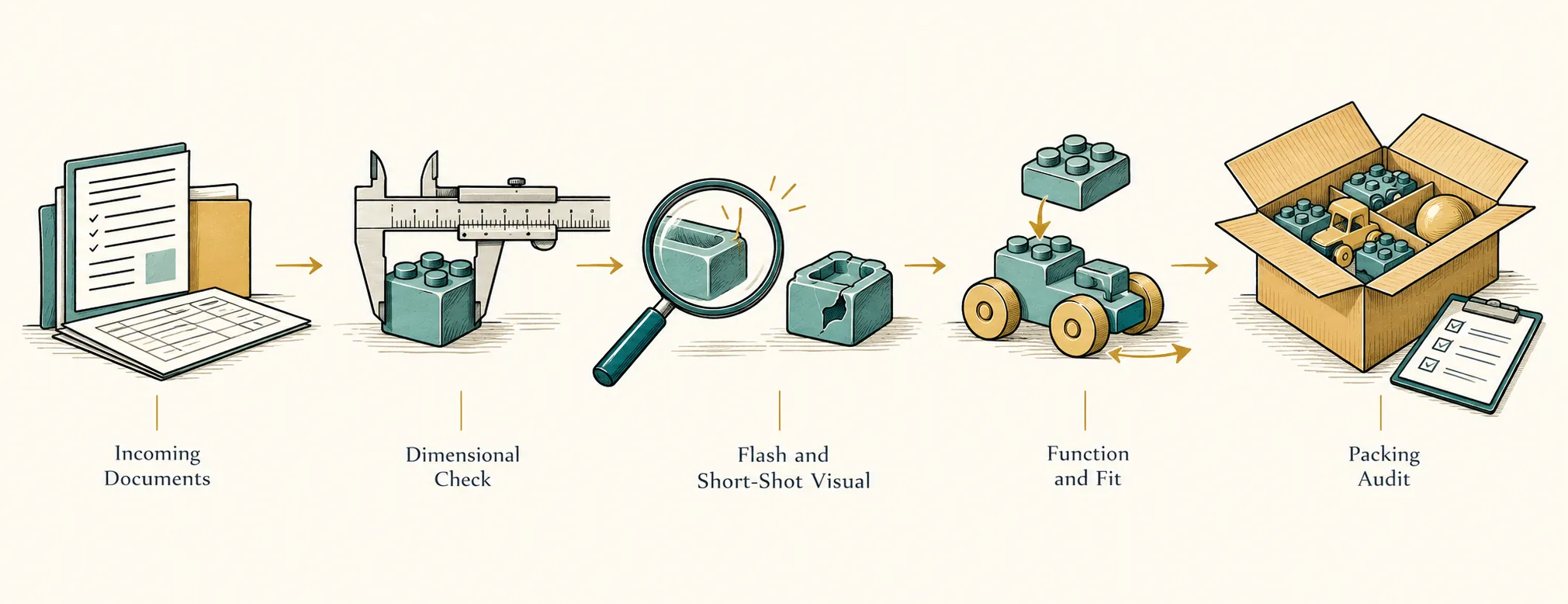
What should be checked on the closed shipping cartons?
| 1. External dimensions and units | Inspect: closed-carton length, width, height, and shape. Compare with: the approved packing specification and proposed dimensions, using the same units and orientation. Discrepancy: unexplained enlargement, bulging, unit conversion error, or a difference outside the agreed tolerance. Next decision: remeasure, identify any configuration change, and update CBM before accepting the revised figures. |
|---|---|
| 2. Carton count and contents allocation | Inspect: physical carton count, carton sequence, and full/partial/mixed identifiers. Compare with: the PO, packing tally, and final carton-level packing list. Discrepancy: missing or duplicate carton numbers, an unlisted partial carton, or a quantity total that does not reconcile. Next decision: reconcile the tally and correct the carton map before releasing affected cartons. |
| 3. Gross and net weights | Inspect: gross weight of the closed carton on a suitable scale; check recorded net weights and their definition. Compare with: the approved packing data and final packing list. Discrepancy: inconsistent units, unexplained weight differences, or net weight exceeding gross weight. Next decision: reweigh and investigate the packing record; a weight difference alone does not establish a shortage. |
| 4. Carton construction and strength | Inspect: the specified board construction, seams, closure, and any visible crushing, tears, moisture damage, or deformation. Compare with: the approved carton specification and any agreed strength-test report for that construction. Discrepancy: substituted construction, failed closure, damage, or a result outside agreed test criteria. Next decision: hold affected cartons for assessment, repacking, or the agreed packaging test. Visual condition alone is not proof of compression strength. |
| 5. Shipping marks and carton identity | Inspect: legibility and agreement of PO reference, item or contents reference, quantity, carton sequence, and buyer-required receiving labels. Compare with: approved shipping-mark artwork and the carton-level packing list. Discrepancy: wrong item, conflicting quantity, unreadable identification, or a mixed carton without a contents reference. Next decision: correct labels and linked records, then verify the correction. |
| 6. Final reconciliation | Inspect: the complete set of carton IDs and shipment totals. Compare with: the approved PO and latest final packing list. Discrepancy: an unapproved substitution, changed assortment, unexplained unit total, or outdated dimensions or weights. Next decision: obtain approval for the change or correct the shipment and documents before release. |
What can a closed-carton check establish about quantity?
A closed-carton check can establish the number and identity of shipping cartons, but exterior labels alone do not verify every unit inside them. Support the contents allocation with packing tallies and the agreed quantity-verification record.
For the hypothetical activity-gym line, the packing list should identify five cartons at 18 units and one partial carton at 10 units, totaling 100. Listing only “six cartons, 100 units” leaves the receiving team without a carton-level allocation.
If a count or weight discrepancy remains unresolved, hold the affected cartons for an agreed contents-verification step and record any resealing. Keep that action distinct from the closed-carton inspection. Carton approval also remains separate from product-safety release; it does not certify the toys.
When is the mixed order ready for approval and restock?
Approve the PO when every selected line has an agreed packing configuration and remainder arrangement; release the shipment when the final packed observations and packing list reconcile with that approval.
Before dispatch, compare the approved quantities and variations with the final packing list, including altered packaging and proposed substitutions. Require approval before replacing an item or changing the assortment. This is a purchasing control, not a claim that any discrepancy inevitably prevents shipment. Mixed-SKU Carton Planning
Finish the record with a clear decision, the affected carton IDs, the responsible approver, and the date. Conditional approval should state exactly what remains to be corrected and who must close it. Preserve photographs, remeasurements, revised labels, or the corrected packing list as closure evidence. The record supports traceability; it cannot by itself reveal an undisclosed packing change.
For the next restock, reuse the approved pack configuration only after confirming that it is unchanged. Convert the required replenishment units into full cartons and remainders again. Carton data helps plan receiving quantities and storage volume; demand and stock policy determine when to reorder.