
Choose a battery-powered toy only when its added function earns a place in the range and its cost, packaging, testing, instructions, and shipping details are ready for approval. Keep the non-powered version when manual play already delivers the intended experience. This battery-powered vs non-powered toys checklist separates meaningful powered functions from decorative effects, then helps buyers record a per-SKU go, no-go, or hold decision without mistaking a product name or advertised run time for verified performance.
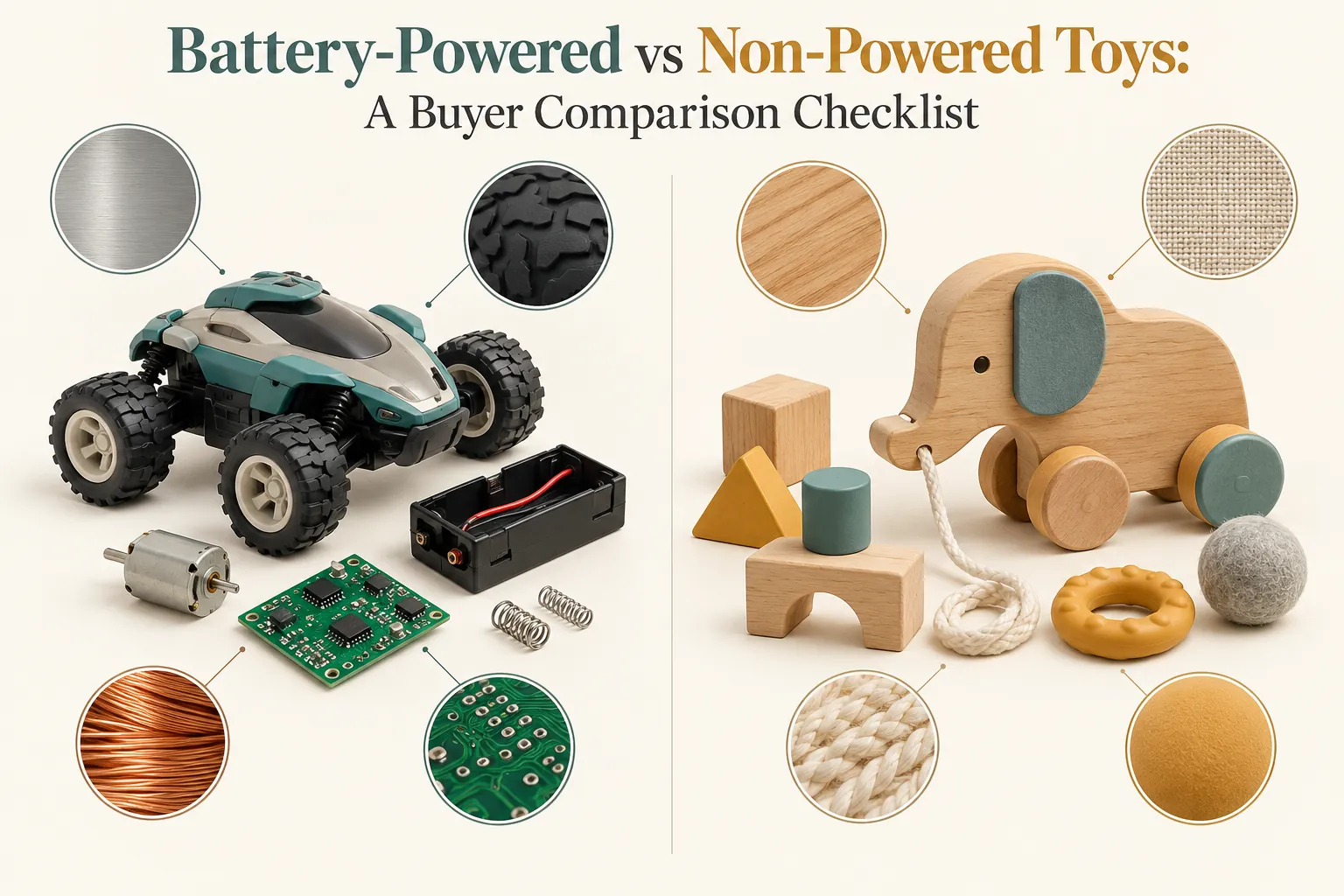
Does the battery change the play, or only add effects?
| Fully non-powered version | No battery-operated function. In the ride-on example, an adult’s push or the child’s feet supply movement. |
|---|---|
| Manual movement with battery effects | Lights or music can use batteries without powering movement. This is not equivalent to a motor-driven ride-on. |
| Motor-driven version | A battery and drive motor supply movement. Confirm the actual controls rather than inferring them from the product name. |
| Charging comparison | Manual propulsion needs no charging for movement; rechargeable powered ride-ons need recharging between sessions. Separate any accessory battery needs from propulsion. |
Which added functions justify a powered SKU?
Approve power for a defined play function, not merely for a longer feature list.
Ask: What can the powered version do that the non-powered version cannot? Who starts, controls, and stops that function? What remains playable when the batteries are removed or discharged? For a ride-on, record what moves the vehicle and who controls speed. For an effects-only version, identify exactly which lights, sounds, or actions disappear without power.
Write one purchase rationale before reviewing the price: “Add powered movement because independent driving is part of this range’s intended play,” or “Keep manual movement because the intended activity is pushing and scooting.” These are selection criteria, not evidence of stronger demand or better sales.
For ride-ons, record the manufacturer’s stated age range, load limit, controls, and intended surfaces separately. Do not substitute a 6V, 12V, or 24V label for those product-specific checks.
What changes in the quote and packed product?
Compare two fully defined configurations on the same commercial basis; a powered version’s quoted price is not meaningful until its included components and packaging are clear.
Request both quotations at the same order quantity, currency, delivery term, and packaging scope. Ask whether the powered price includes batteries, a charger if applicable, a remote control if specified, assembly accessories, and the agreed instructions. Separate optional accessories and one-time artwork or packaging charges from the unit quote.
Ask for packed dimensions, gross weight, carton quantity, and the packing layout for each version. Check how the battery and accessories are retained, whether controls can activate during handling, and whether extra assembly changes the unpacking instructions. Do not assume a powered variant fits the original carton—or that it necessarily needs a larger one.
Use the actual quotations to decide the acceptable premium. One retailer describes its push cars as entry-level and its powered cars as a higher price tier, but that qualitative comparison is not a wholesale price benchmark. Push Car vs Ride-On Car
Which test records and battery instructions should you compare?
Review evidence against each version’s actual construction and intended destination; do not assume the non-powered version’s test file covers the powered configuration.
Ask for report identifiers, tested model descriptions or photographs, applicable standards and editions, and a clear explanation of which configurations the reports cover. Compare those descriptions with the proposed battery, electrical functions, accessories, and packaging. A shared product name alone is not a coverage check. Equally, a different internal SKU does not automatically require a separate test: coverage follows the tested construction and applicable rules.
For the powered version, request battery chemistry, nominal voltage, capacity, battery quantity, whether batteries are included, and whether they are replaceable or rechargeable. Where rechargeable, request the charger model and specifications. As a purchasing check, have the technical reviewer compare chemistry, charging voltage profile, current limit, connector, and polarity—not just the connector’s appearance.
Review the actual instruction artwork in the destination languages you specify. Check battery installation and polarity, replacement or charging steps, charger identification where applicable, storage guidance, and product-specific warnings. A manual for a similar-looking toy is not the approved manual for this configuration.
These are buyer review steps, not a declaration that either version meets every market requirement. Commercial sample checks also do not replace applicable safety testing.
How should run time and charging time affect the decision?
Treat advertised run time as a conditional estimate and assess charging time separately.
For ride-on cars, run time varies with the battery, motor, rider weight, terrain, temperature, and driving style. Keep those conditions attached to any figure passed to merchandising or sales; do not convert an advertised estimate into an unconditional customer promise. Best Buy Canada
Ask: Was the run-time figure measured continuously or intermittently? Under what load and surface conditions? Were lights and sounds operating? What was the starting charge condition, and what ended the test? For a quoted capacity, request its discharge rate, temperature, and cutoff conditions as well as its voltage and Ah value.
Set a sample acceptance target suited to the intended play session, record the test conditions, and compare the observation with that target. Label this as a buyer performance check, not a compliance standard. If frequent recharging conflicts with the intended use, retain the non-powered option even when the powered sample otherwise works as described.
What must logistics know before quoting the powered version?
Give the forwarder the proposed battery configuration before accepting the powered version’s freight comparison.
Send the battery chemistry, voltage, capacity, quantity, and whether batteries are installed, packed alongside the toy, or shipped separately. Include battery mass and Wh information where relevant, plus carton dimensions, gross weight, destination, and proposed transport mode. Ask the forwarder to identify the documentation, packing conditions, service acceptance, and charges for that exact shipment.
Request comparable freight quotations with the same delivery endpoint and an explicit breakdown of included services and charges. Do not assume that a quote for the battery-free version applies unchanged to the powered version.
For a genuinely battery-free SKU, state that no batteries are included in the shipment. A manually propelled toy with included light or sound batteries still needs those batteries described; “not motor-driven” is not the same as “battery-free.”
How does the checklist resolve a push-car comparison?
A battery-effects push car should be evaluated as an effects upgrade, not as an electric-drive upgrade.
Consider a manually propelled push car against a candidate marketed as a “battery powered push car.” If the listing mentions music and lights but does not describe a drive motor or driving controls, do not approve it for a range gap that calls for self-propulsion. Confirm movement on the sample and obtain a precise function description. The listing name alone does not resolve the question. Push Car vs Ride-On Car
The bounded decision is straightforward: hold approval as a motor-driven SKU until propulsion is confirmed. If it proves to be effects-only, assess whether those effects justify the quoted premium and additional battery handling. If the intended play is simply pushing and scooting, choose the non-powered version unless the effects meet a separately stated range requirement.
This comparison establishes functional fit. It does not establish test coverage, packed dimensions, or shipment acceptance; those checks remain separate approval conditions.
What should the per-SKU decision record contain?
Close each comparison with an explicit go, no-go, or hold outcome tied to the exact version reviewed.
Identify the base and powered versions, supplier, destination market, quotation revision, sample reference, packaging revision, and instruction revision. For each of the six comparison areas—function, cost, packaging, testing, battery instructions, and shipping—record the specified target, the observed result or document reference, and whether the result is accepted.
Use “Go—add or retain the powered version” when its function serves the range requirement and the approval conditions are closed. Use “No-go—retain the non-powered version” when the added function does not justify the commercial or operational trade-off. Use “Hold—need more information” when a consequential question remains unresolved; a hold is not proof of product failure or supplier misconduct.
Assign a responsible approver and decision date. Turn each open point into a direct request, such as “Confirm whether the motor drives the wheels,” “Provide the battery and charger specifications for this revision,” or “Confirm packed dimensions and forwarder acceptance for the proposed battery configuration.” Give each action an owner and due date, then record the reply, closure evidence, closure date, and any revised approval.
The record makes the decision traceable. It does not itself prevent an undisclosed component change, so identify the approved configuration clearly in the order and subsequent inspection instructions.