
Approve private-label artwork for mixed wholesale toys line by line, not with a blanket purchase-order sign-off. A sliding ambulance with sound and lights in a display box needs a different artwork check from a counting toy listed with single-item packing. Use one handoff record per SKU, pack version, and market-language version. Release only the named artwork revision after its visual checks pass, while recording physical-sample, safety-document, and commercial confirmations separately so an approved logo never becomes accidental approval of the whole product.
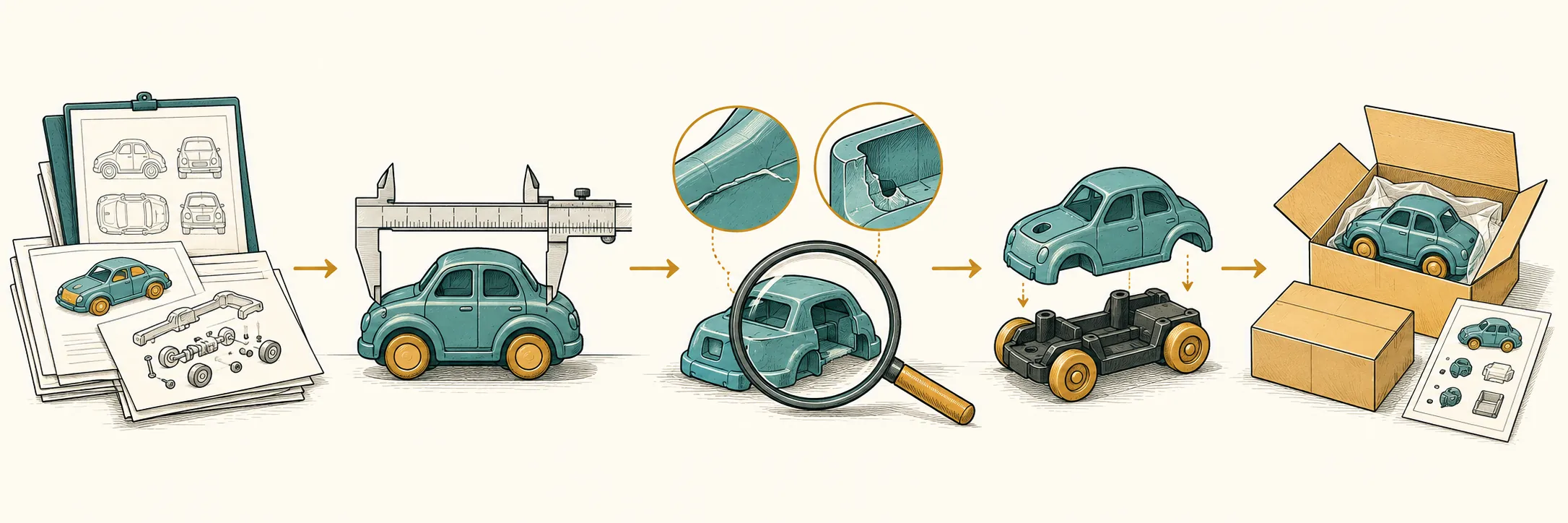
How should artwork checks differ across pack types in one mixed order?
| Sliding ambulance with sound and lights — display box | Reference MOQ: 108 units. Check the artwork against the proposed assembled display, including which panels remain visible and whether graphics obscure the product. Confirm units per display and units per shipping carton separately before planning replenishment. |
|---|---|
| Balance-counting STEM toy — single-item packing | Reference MOQ: 108 units. Obtain the proposed individual-pack layout before approving panel placement; “single-item packing” alone does not establish a box shape or printable area. Keep this proof separate from the vehicle’s display-box artwork. |
| Dinosaur swallowing-car play set — tool box | Reference MOQ: 48 units; recorded shipping-carton quantity: 48 units. Identify the proposed branding surface—such as an agreed label or outer packaging—and check its actual fit. Do not reuse a display-box layout without a matching proof. |
What does an artwork approval actually confirm?
Artwork approval confirms the specified visual instructions for branding and packaging; it does not confirm the finished toy’s physical performance or safety.
Approve the exact file revision, logo, orientation, dimensions, placement, text, barcode or QR data, and package layout. These are artwork checks, not a substitute for examining the product. Artwork proof checklist
Keep sample observations separate: the ambulance’s sound and light operation, physical color match, ink adhesion, assembled packaging fit, and packaging strength cannot be established by a flat proof. Nor does a proof establish age suitability or laboratory results. Reference the relevant sample and destination-document review in the handoff rather than marking those matters approved because the graphics look correct.
What belongs in the per-SKU artwork handoff worksheet?
| Order and product identity | Record the purchase-order number and line, internal SKU, product description, color or assortment variant, order quantity, destination, and language version. Observation: confirm that the proof depicts the intended product and variant. |
|---|---|
| Controlled artwork files | Name the final proof, production artwork file, revision, and issue date. Identify the matching editable source where used. Observation: confirm that all attached files belong to the same revision and record the approval-copy location. |
| Artwork scope and pack reference | Specify whether approval covers the toy decoration, individual pack, display, insert, label, or shipping-carton mark. Reference the relevant layout or dieline revision and physical sample. Observation: identify the exact surfaces reviewed. |
| Logo, color, size, and placement | Target: approved brand asset, color reference, orientation, dimensions, placement datum, and quoted decoration method. Observation: record the proof’s dimensions and position, plus any deviation. Keep physical color matching as a separate sample decision. |
| Copy, imagery, and product claims | Target: approved spelling, numbers, URLs, contact details, translations, and product imagery. Observation: compare the proof with the approved copy. Route age statements, function claims, warnings, and marks to the designated product or destination reviewer before accepting their content. |
| Barcode and QR code | Target: assigned data, intended destination, placement, and final printed dimensions. Observation: decode the proof and compare the result with the assigned record. Where relevant, record a separate scan check on a representative printed pack; a screen scan does not establish printed performance. |
| Panel and assembled-pack checks | Target: identified front, back, sides, folds, cuts, label boundaries, and insert positions. Observation: note reversed panels, hidden text, clipped graphics, or interference with product visibility. Reference an assembled sample when fit or structure matters. |
| Packing and replenishment link | Record the agreed individual-pack configuration, display quantity where relevant, shipping-carton quantity, and commercial confirmation reference. Keep reference MOQ separate from the accepted order terms. Assign an owner and due date to any packing confirmation still open. |
| Separate product and safety confirmations | Reference the physical sample and applicable product or destination documents, their review status, and the responsible reviewer. State unresolved conditions explicitly; do not convert artwork approval into product or safety approval. |
| Artwork decision and approver | Record “approved,” “revise and resubmit,” or “on hold,” with the controlling filename and revision. Include the named artwork approver, role, approval date, and any conditions. A requested correction requires a revised proof before artwork release. |
| Production-release authorization | Name the person authorized to release the order or affected line, record the authorization date, and identify the recipient’s acknowledgment of the controlling revision. State whether separate sample, document, or commercial conditions block release. |
| Follow-up closure | For every open action, record the issue, responsible owner, due date, closing evidence, closure date, and person accepting closure. Preserve the final decision with the approved files. |
When is an artwork version ready for production release?
Release a version only when its artwork checks are complete, a named approver has accepted that exact revision, and any conditions blocking production have been closed by the responsible owner.
Keep three decisions distinct: the artwork is visually approved; the product and documents have their own review status; the affected order line is authorized for production. One person may hold several roles, but the record should still show what was approved.
For a bounded mixed-order example, suppose the ambulance display proof uses the correct logo but encodes the wrong item identifier. Mark that artwork “revise and resubmit.” A separate counting-toy proof with correct data can receive its own artwork approval; it does not have to inherit the display’s correction. Conversely, correct graphics do not authorize either line while a specified sample or document condition remains open.
Do not write “approved subject to fixing the barcode” and leave the same file in circulation. Obtain the corrected revision and approve that file.
What must the post-approval change log capture?
| Change identity | Record the affected purchase-order line and SKU, change-request date, requester, previous approved revision, proposed revision, and exact change. |
|---|---|
| Impact and disposition | Identify affected toy decoration, packs, labels, displays, or carton marks. Record whether a new proof, physical sample, commercial confirmation, or schedule assessment is required, with the owner for each action. |
| Approval and closure | Record the new proof-review result, approver and date, closure evidence for release conditions, recipient acknowledgment, and the status of the superseded files. |
Which artwork should control a replenishment order?
Use the last approved revision that matches the replenishment product, pack, market, and language—not simply the newest file in an email thread.
Reference that revision on the new order line and confirm whether the product, layout, code data, or pack configuration has changed. Reconfirm current order terms and carton quantities separately; a recorded MOQ is a minimum reference, not an order multiple.
Retain the approved proof, release acknowledgment, and closed change log together. This creates a traceable handoff, but the record alone cannot detect an undisclosed substitution or prove that production used the approved file.